Buying a remote control lawn mower can look straightforward when every product page lists cutting width, engine displacement and maximum slope capability. In practice, two machines with similar specifications may perform very differently on wet grass, loose soil, narrow orchard rows or heavily overgrown land.
Commercial buyers should therefore start with the worksite rather than the engine. The best machine is not always the largest or most powerful model. It is the mower that matches the terrain, vegetation, access conditions and expected daily workload.
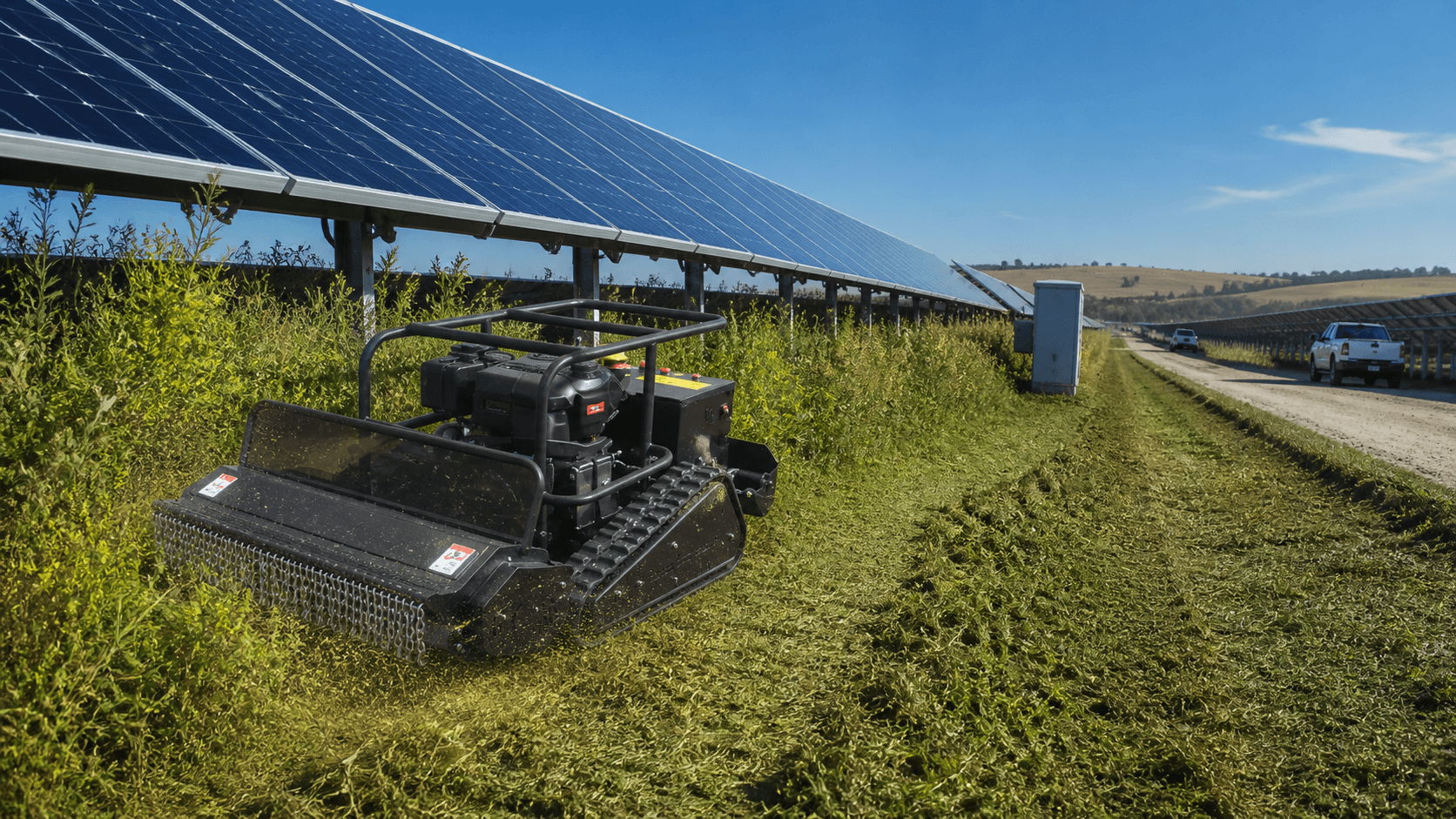
This guide explains how to compare a wheeled or tracked remote control mower for orchards, solar farms, roadsides, embankments, drainage channels and commercial vegetation-management projects.
1. Define the Mowing Application
A useful product comparison begins with a clear description of the job. “Cutting grass on a slope” does not provide enough information for an accurate recommendation.
The supplier should know where the machine will work, how often the site is maintained and what kind of vegetation is present. Common applications include:
Orchards and vineyards
Solar farms
Highway embankments
Roadside vegetation
Dams and riverbanks
Drainage channels
Retention ponds
Municipal parks
Industrial properties
Large private estates
Tall grass and dense weed clearance
An orchard may require a compact machine that can pass between trees. An open solar farm may benefit from a wider cutting deck. A roadside contractor dealing with rough weeds may need a flail system rather than a mower intended for maintained grass.
The application should guide the configuration.
Record the Worksite Conditions
Ground conditions have a direct effect on traction and stability. Buyers should record whether the surface is firm, muddy, sandy, rocky or covered with wet grass.
Access also matters. Measure the narrowest gate, orchard row or passage between solar-panel supports. Check for low panels, cables, tree branches, drainage structures and soft edges near water.
Photos are useful, but continuous worksite video usually gives a clearer picture. A video can show vegetation density, ground irregularities, turning space and changes in slope.
2. Understand Slope Ratings
Slope capability is an important specification for any mower for steep slopes, but the number must be read correctly.
Some manufacturers express slope in degrees. Others use percentage gradient. These units are not the same. A 100% gradient is approximately 45 degrees, while a 50% gradient is about 26.6 degrees.
Buyers should also ask what the published figure represents:
Maximum climbing ability
Recommended working slope
Cross-slope operating ability
Short test limit
Continuous cutting limit
A mower may climb straight up a surface that it should not cross laterally while cutting. Climbing, descending and working across a slope place different forces on the machine.
Ask About the Test Conditions
A maximum slope figure should not be treated as a guarantee for every site. Real performance can change with:
Wet or slippery grass
Loose soil or gravel
Vegetation density
Travel direction
Cutting load
Fuel or battery position
Track or tire condition
Installed attachments
Ask whether the machine was cutting during the test and whether the surface was dry, firm and free of vegetation. The supplier should explain whether the result applies to regular work or only to a short demonstration.
Operators must follow the model-specific manual. Wet weather can reduce traction and safe working limits, even when the machine has previously worked on the same slope.
3. Compare Wheeled and Tracked Mowers
Wheeled and tracked machines solve different problems. Neither drive system is automatically best for every buyer.
A wheeled remote controlled lawn mower can be a practical choice for maintained grass, relatively firm ground and sites that require frequent turning. Wheels may offer quicker travel and less surface disturbance when the ground is suitable.
Tomai offers two 500 mm wheeled models:
ModelCutting widthPowerTM196-500500 mm196 cc gasolineTM224-500500 mm224 cc gasolineTheir compact dimensions make this product class relevant to gardens, landscaped properties, orchard rows and other areas where access and maneuverability matter.
When a Tracked Design Makes Sense
A tracked remote control mower places a larger contact area on the ground. This can improve grip and distribute machine weight more evenly than a typical wheeled arrangement.
Tracked models are commonly considered for:
Sloped ground
Loose soil
Uneven terrain
Soft orchard surfaces
Embankments
Wet working areas
Sites with small ruts or depressions
The Tomai standard tracked range includes three cutting widths:
ModelCutting widthAvailable powerTM-550L550 mm196 or 224 ccTM-800L800 mm452 or 608 ccTM-1000L1,000 mm452 or 608 ccThe 550 mm model emphasizes compact access. The 800 mm and 1,000 mm versions provide wider coverage for larger areas. Buyers can compare the available power configurations according to vegetation load and working conditions.
Tracks can disturb delicate turf during sharp turns, so turning behavior should be considered when the mower will work on finished lawns.
4. Consider Tank-Style Tracked Mowers
Tank-style tracked machines are designed for buyers who need a wider platform and several power choices for demanding commercial work.
The Tomai tracked tank mower range includes:
ModelCutting widthAvailable powerTM-800T800 mm452, 608, 764 or 810 ccTM-900T900 mm452, 608, 764 or 810 ccTM-1000T1,000 mm452, 608, 764 or 810 ccTM-1200T1,200 mm608, 764 or 810 ccThis range gives buyers four cutting-width options from 800 to 1,200 mm. The available power also increases across several configurations.
A wider machine may improve coverage on open land, but width alone does not determine productivity. A buyer must also consider transport, entrances, turning space, vegetation resistance and the operator’s route.
Check Stability as a Complete System
Track width is only one part of stability. Buyers should also examine:
Center of gravity
Machine width and height
Engine location
Fuel-tank position
Cutting-deck position
Weight distribution
Installed attachments
Recommended travel direction
A low center of gravity can support stable operation, but no single feature proves that a machine is suitable for every slope. The complete configuration must be evaluated under defined conditions.
Where possible, request unedited video showing the machine starting, cutting, turning and stopping on terrain similar to the intended worksite.
5. Match the Cutting System to Vegetation
The drive system moves the machine, but the cutting system determines what it can process.
Rotary mower decks are commonly used for grass and routine vegetation maintenance. They can deliver efficient cutting and a relatively tidy finish where the material is not heavily woody.
A remote-controlled flail mower is generally considered for dense weeds, coarse vegetation and demanding clearance work. The individual flails process material differently from a conventional rotary blade.
Tomai offers three remote-controlled flail mower models:
ModelCutting widthAvailable powerTM-900S800 mm420 cc gasoline, Kyl19-2, CC195 or KP195 dieselTM-1000S1,000 mm622 cc gasoline, Kyl195, CC195, KP195 or KP295 dieselTM-1200S1,200 mm622 cc gasoline, KP195 or KP295 dieselThe choice between these models should be based on vegetation, access width and workload rather than cutting width alone.
Describe the Vegetation Accurately
Before selecting a cutting deck, tell the supplier:
Average vegetation height
Maximum vegetation height
Grass, weeds or mixed growth
Presence of light woody material
Vegetation density
Required finished appearance
Mowing frequency
Presence of stones or debris
Vegetation cut every two weeks creates a different load from growth left untouched for a full season. If the site includes several vegetation types, identify the most demanding section.
Any claimed maximum cutting diameter should be supported by documentation or a demonstration for the selected model.
6. Choose an Appropriate Power Configuration
Remote mower power systems may use gasoline, diesel, battery-electric or combined arrangements. Each option changes daily operation.
Gasoline engines can provide a practical balance of availability, field refueling and purchase cost. Diesel options may suit sustained commercial work, depending on engine configuration and local service access.
Electric equipment can reduce noise and produces no exhaust emissions at the point of use. Buyers still need to examine battery capacity, charging time, expected runtime, replacement cost and electricity access.
Do not rely on the power-source label alone. Ask what drives the tracks, what drives the cutting deck and how the system behaves under heavy load.
Plan Around a Normal Working Day
The right configuration should match the daily schedule. Consider:
Expected operating hours
Travel distance
Vegetation load
Refueling or charging opportunities
Noise restrictions
Local fuel availability
Access to engine or electrical service
Published fuel-use and runtime figures depend on working load. Request the relevant test conditions before using them to calculate operating cost.
7. Look Beyond Cutting Width
Cutting width is easy to compare, but it does not equal actual output.
Productivity is also influenced by:
Average working speed
Vegetation density
Overlap between passes
Turning time
Terrain complexity
Refueling or charging
Inspection and cleaning
Operator experience
Required cutting height
A 1,200 mm commercial slope mower may cover open ground efficiently. A 550 mm machine may complete a narrow orchard faster because it can pass between trees and turn without repeated repositioning.
The machine with the widest deck is not always the machine with the shortest completion time.
Estimate Output From Real Conditions
A useful productivity estimate should begin with average working speed and usable cutting width. It should also allow for overlap, turns, obstacles and service stops.
There is no single dependable “industry average” that covers every remote mower. Compact rotary machines and large flail mowers perform different work. Grass height, slope and soil conditions also change output.
Ask the supplier to state the assumptions behind any productivity figure. A trial area or continuous demonstration provides stronger evidence than a theoretical maximum.
8. Review the Safety Controls
Remote operation helps keep the operator away from difficult terrain, but it does not remove every risk. Rotating components, unstable ground and thrown debris still require careful control.
Depending on the selected model, buyers should verify:
Emergency-stop operation
Response to lost remote signal
Blade-engagement protection
Protective deck guards
Machine-status indicators
Warning lights or alarms
Engine or motor protection
Restart procedure after a fault
Ask what happens to travel and cutting functions if the controller loses communication. The answer should appear in the operating manual.
Manage the Working Area
The operator should keep the mower within sight and maintain the safety distance specified for the model. Other people, animals and vehicles must remain outside the work zone.
Inspect the area for stones, wire, branches and metal objects before cutting. These materials may damage the deck or be thrown by the cutting system.
The operator should also reassess the site after heavy rain, erosion or construction. Familiar land can develop new holes, soft edges and hidden hazards.
9. Calculate Ownership Cost
Purchase price is only one part of equipment cost. Downtime, wear parts, international freight and maintenance can have a larger effect over the machine’s service life.
Before ordering, ask about:
Blade or flail replacement
Belts and bearings
Track or tire replacement
Filters and lubrication points
Engine maintenance
Electrical-system service
Controller replacement
Diagnostic support
Warranty coverage
Spare-parts dispatch time
A lower initial quotation may become more expensive if a common wear part is difficult to identify or takes weeks to ship.
Order Essential Parts With the Mower
International buyers should consider ordering an initial wear-parts package with the machine. The exact package depends on the model, but it may include blades or flails, belts, filters, bearings and specified fasteners.
Request part numbers and replacement instructions. English manuals, maintenance videos and remote technical support can reduce diagnostic time.
Tomai buyers should confirm the recommended spare-parts package for the selected wheeled, L-series tracked, T-series tank or S-series flail mower before shipment.
10. Check Documents and Supplier Support
Import requirements vary by destination and configuration. Buyers should request the documents needed for their own market.
Qingdao Tomai Intelligent Machinery Technology Co., Ltd. supplies products for customers in multiple countries and reports CE-, RoHS- and FCC-related compliance across its product or component range. Because these requirements cover different areas, buyers should match the available documentation to the ordered mower, engine, controller and destination market.
A professional purchasing review may cover:
Product identification
Applicable declarations and reports
Engine or emissions documentation
Radio-control documentation
Battery transport files where applicable
User manuals
Warranty terms
Technical support
OEM branding
Packaging and shipping requirements
Compliance logos should be supported by documents that correspond to the supplied configuration.
11. Prepare a Clear Request for Quotation
A detailed inquiry helps the supplier recommend the right machine and reduces unnecessary messages.
Include the following information:
Destination country
Primary application
Total working area
Vegetation type and height
Normal and maximum measured slope
Dry, wet, muddy, rocky or loose ground
Narrowest access width
Maximum permitted machine height
Expected daily working hours
Preferred cutting system
Preferred power type
Spare-parts and OEM requirements
Add photos or video of the worksite. If possible, show how the slope was measured.
12. Compare Tomai Models by Application
The current Tomai range covers compact wheeled mowers, standard tracked machines, tank-style tracked mowers and flail mowers.
For compact access and maintained grass, buyers can evaluate the TM196-500 and TM224-500 wheeled models.
For orchard rows, landscaped slopes and general vegetation management, the TM-550L, TM-800L and TM-1000L provide cutting widths from 550 to 1,000 mm.
For wider commercial work, the TM-800T, TM-900T, TM-1000T and TM-1200T cover widths from 800 to 1,200 mm, with several engine displacement options.
For dense vegetation, the TM-900S, TM-1000S and TM-1200S flail range offers gasoline and diesel configurations.
These categories make preliminary selection easier, but the final recommendation must still consider terrain, vegetation and operating conditions.
Remote Control Lawn Mower Questions
Q1: Which Remote Control Lawn Mower Should I Buy?
A: Choose the model that matches the measured worksite rather than the machine with the largest engine.
A 500 or 550 mm mower may be more practical in narrow passages, while an 800 to 1,200 mm model may cover open land more efficiently. Because there is no universal industry-average output for different terrain and vegetation, compare models using the same site conditions.
Send the supplier your slope measurements, vegetation details and access dimensions before requesting a final recommendation.
Q2: Is a Tracked Remote Control Mower Better on Slopes?
A: Tracks are often better suited to soft, uneven and sloped ground because they provide a larger contact area.
Wheeled machines may travel and turn more efficiently on firm, maintained surfaces. Real traction depends on machine weight, track design, soil, moisture and travel direction, so a single industry-average value would be misleading.
Request a demonstration on terrain similar to your site.
Q3: How Safe Is a Remote Controlled Lawn Mower?
A: Remote operation can reduce the operator’s exposure to hazardous ground, but safe work still depends on equipment condition and correct procedures.
Buyers should confirm emergency-stop behavior, signal-loss response, deck guarding and the model’s required safety distance. Wet grass and loose soil can reduce traction compared with dry test conditions.
Qingdao Tomai Intelligent Machinery Technology Co., Ltd. can match buyers with wheeled, tracked, tank-style or flail configurations. Ask for the selected model’s operating instructions before use.
Q4: What Makes a Commercial Slope Mower Suitable for Daily Work?
A: A commercial machine needs an appropriate cutting system, serviceable components and dependable parts support.
There is no meaningful industry-average productivity figure unless cutting width, vegetation, slope, speed and downtime are measured under the same conditions. Buyers should compare maintenance schedules, wear-parts lists and supported working limits instead.
Tomai offers cutting widths from 500 to 1,200 mm across the models listed in this guide. This range allows buyers to select equipment around access and workload rather than relying on one oversized platform.
Q5: Which Mower for Steep Slopes Fits Dense Vegetation?
A: A flail mower is generally the more relevant starting point for dense weeds and rough vegetation.
Tomai’s TM-900S, TM-1000S and TM-1200S cover listed cutting widths of 800, 1,000 and 1,200 mm. Gasoline and diesel options vary by model. The correct choice depends on vegetation density, access, daily workload and local engine support.
Buyers should send worksite video and request a cutting demonstration before confirming the order.
Q6: How Should I Compare Remote Mower Quotations?
A: Send every supplier the same worksite information and compare equivalent configurations.
Check the mower model, engine, cutting width, included controller, spare parts, warranty, documentation, packaging and shipping terms. Unsupported output figures should not be treated as industry averages.
A useful quotation clearly states what is included, which specifications are confirmed and what after-sales support is available.
Conclusion
Selecting a remote control lawn mower requires more than checking price, cutting width and engine displacement. Terrain, slope measurement, vegetation, drive system, cutting deck, safety controls and maintenance support determine whether the machine fits the job.
The Tomai range provides several starting points: 500 mm wheeled machines, 550 to 1,000 mm standard tracked models, 800 to 1,200 mm tank-style mowers and 800 to 1,200 mm flail mowers.
Buyers should send Qingdao Tomai Intelligent Machinery Technology Co., Ltd. their destination country, worksite dimensions, slope measurements, vegetation details and expected working hours. The Tomai team can then compare suitable configurations and prepare a project-specific quotation.