Steep hills, uneven orchard floors, overgrown fields and roadside embankments create challenges that rarely appear on a maintained lawn. A conventional wheeled mower may lose traction, sink into soft ground or become difficult to control when the surface changes. Tall grass and dense weeds add another demand: the mower must continue moving while its cutting system remains under load.
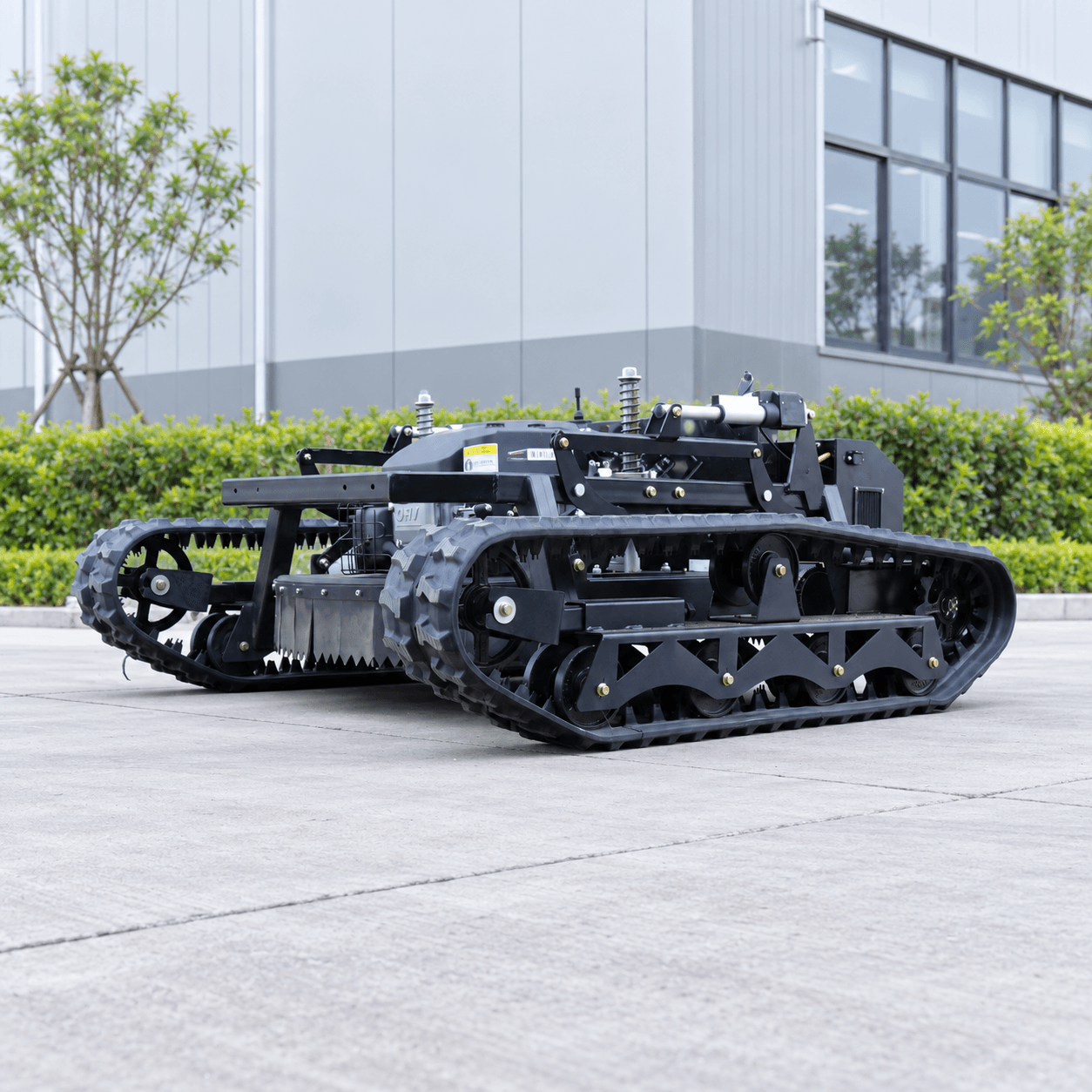
A tracked remote control mower is designed for these difficult conditions. Its tracked undercarriage distributes the machine’s weight across a larger contact area than a typical wheel. Remote operation also allows the operator to control the mower without sitting directly on the machine.
However, a tracked chassis does not make every machine suitable for every slope. Ground moisture, vegetation density, machine weight, cutting-deck design and operator position still influence performance. A professional buyer should assess the complete machine and the worksite rather than relying on one maximum specification.
This guide explains how a Remote Control Lawn Mower can work on difficult terrain, with particular attention to traction, cutting performance, stability, safety and commercial productivity.
Why Rough Terrain Changes Mower Selection
A mower that performs well on level turf may struggle only a short distance away on loose soil or a wet bank. Rough ground changes how the drive system transfers power to the surface. It also affects how the chassis moves and how consistently the cutting deck follows the vegetation.
Common problem areas include:
Small depressions and ridges
Exposed roots
Loose stones
Mud and wet grass
Concealed holes
Soft soil near water
Dense or tangled vegetation
Narrow passages and limited turning areas
Long grass can hide these hazards until the mower reaches them. Near ditches, riverbanks and retention ponds, erosion may also create a weak edge that appears firm from a distance.
Professional safety guidance recommends assessing the site before choosing mowing equipment. Slopes, wet surfaces, drop-offs, embankments and bodies of water all require particular attention.
Four Questions to Ask Before Choosing a Mower
A buyer can narrow the available options by answering four practical questions.
What is the ground like?
Record whether the surface is firm, sandy, muddy, rocky or covered with wet vegetation.
What must the machine cut?
Maintained grass, tall weeds and light woody growth place different loads on the cutting system.
How steep is the site?
Measure the normal working area and the steepest isolated section. Visual estimates of slope angle are often inaccurate.
Can the machine reach the site?
Measure gates, orchard rows, passages beneath solar panels and available turning space.
These details are more useful than asking only for a “powerful mower.” They allow the supplier to match machine width, drive system, cutting deck and power configuration to the actual application.
How a Tracked Remote Control Mower Works
A tracked undercarriage uses continuous tracks instead of individual drive wheels. The tracks create a relatively long contact area, spreading the machine’s mass over more ground.
The design can also keep more of the drive system in contact with an irregular surface. This is useful when a machine crosses small depressions, loose soil or uneven orchard ground.
Tracks do not create unlimited grip. Traction still depends on:
Track design and condition
Machine weight
Surface material
Ground moisture
Direction of travel
Vegetation beneath the tracks
Steering input
Working speed
Remote steering lets the operator control forward movement, reverse movement and turning from a separate position. Depending on the model, the controller may also manage cutting functions, deck height or an emergency stop.
Buyers should verify the controls fitted to the exact model. Not every remote controlled lawn mower includes the same functions.
Tracks on Soft and Uneven Ground
Soft orchard soil and recently disturbed land can cause narrow wheels to sink or leave deep marks. A tracked chassis spreads its load more widely, which may reduce local sinking under comparable conditions.
Tracks can also bridge small depressions and maintain contact while passing over minor surface changes. This helps the mower continue moving where a wheel might fall into a rut or lose contact.
On gravel or loose soil, a longer contact area may improve traction. Sharp stones and debris can also increase track wear, so the undercarriage should be inspected regularly.
A buyer should request operating footage from terrain similar to the intended worksite. A demonstration on concrete or short grass does not show how the machine behaves on wet vegetation, loose earth or uneven ground.
Where a Tracked Mower Has LimitsTracks are not automatically the right choice for every surface. A tracked machine that turns by skidding can disturb finished turf during a sharp turn.
Track tension also requires routine inspection. A damaged track or drive component can stop the machine even when the engine and cutting system remain operational.
Wet clay, saturated grass and loose material may still reduce traction. The operator should never assume that tracks eliminate the possibility of sliding.
Weather and ground conditions should be checked before each shift and whenever conditions change.
Choosing a Mower for Steep Slopes
A mower for steep slopes needs more than engine power. It requires suitable traction, balanced weight distribution, stable steering and a cutting system that does not overload the chassis.
Buyers should be careful when comparing maximum slope claims. One figure may represent a short, straight climb on a dry test surface. Another may describe continuous cutting, while a third may refer to cross-slope travel.
These tests do not represent the same operating condition.
Published safety guidance notes that working limits vary between mower models. It also warns that the recommended working gradient may be lower in wet conditions. The operator must follow the manual supplied with the selected machine.
Degrees and Percentage Gradient
Slope figures are commonly expressed in degrees or percentage gradient. The two units are related, but they are not interchangeable.
A 100% gradient is approximately 45 degrees. A 50% gradient is approximately 26.6 degrees. A machine advertised for a 50% slope should not be interpreted as a machine rated for 50 degrees.
When slope performance affects the purchase decision, ask how the figure was measured.
The supplier should identify:
Surface condition
Direction of travel
Machine configuration
Installed cutting system
Whether the blades were operating
Whether the result was temporary or continuous
If this information is unavailable, the figure should be treated as an unverified maximum rather than a normal working limit.
Climbing Is Not Cross-Slope Cutting
A machine may climb directly uphill while remaining aligned with the slope. Cross-slope travel distributes the machine’s mass differently and can change the risk of sliding or overturning.
Stopping, reversing and turning also affect stability. A short climbing demonstration does not prove that the same angle is appropriate for continuous lateral mowing.
Commercial buyers should request separate information about:
Maximum climbing capability
Recommended continuous working limit
Cross-slope operating guidance
Wet-weather restrictions
If the manufacturer does not publish one of these values, it should be marked as unknown instead of estimated.
Cutting High Grass and Dense Vegetation
Terrain mobility is only useful when the mower can process the vegetation in front of it.
High grass may bend beneath a cutting deck, collect around moving parts or place a sustained load on the engine. Dense weeds often require a slower travel speed so the cutting system has enough time to process the material.
A front cutting area can make the work zone easier to observe as the machine advances. Protective structures around the cutting deck may help contain cut material, but guards cannot remove every risk created by stones, wire or hidden debris.
Before recommending a mower, the supplier should know:
Average vegetation height
Maximum vegetation height
Stem thickness
Vegetation density
Moisture conditions
Required cutting finish
Frequency of mowing
An area cut every two weeks creates a different workload from land left unmanaged for an entire season.
Rotary Deck or Flail Cutting System
A rotary deck commonly uses one or more horizontal blades. This design is often selected for grass and routine vegetation maintenance where a relatively even finish is required.
A flail system uses multiple individual cutting elements mounted on a rotating shaft. It is commonly considered for dense weeds, coarse growth and rough commercial clearing.
The exact capability depends on:
Flail or blade design
Rotor construction
Available engine power
Working speed
Vegetation density
Cutting height
Ground conditions
Neither system should be selected from its name alone. Buyers should ask which vegetation the model is designed to process, which cutting parts wear during normal work and how those parts are replaced.
Any claim about maximum cutting diameter should be supported by model-specific documentation or a relevant demonstration.
Hidden Debris and Discharge RiskStones, wire, discarded hardware and branches can remain hidden beneath long vegetation. These objects may damage the cutting system or be thrown from the work area.
The operator should inspect the site before mowing and establish an exclusion zone based on the manufacturer’s instructions.
People, animals and vehicles should remain outside the working area. Guards, site inspection and safe operating distances must be treated as operating requirements, not optional precautions.
Stability on Changing Ground
A wide tracked stance and low center of gravity can contribute to machine stability, but these features do not work alone.
Engine position, fuel level, battery location, cutting-deck weight and installed attachments can change the balance of the mower.
Uneven ground also introduces movement into the chassis. If one track crosses a ridge while the other enters a depression, the mower may tilt even when the average slope looks moderate.
Buyers should examine how the undercarriage follows surface changes and whether the cutting deck remains controlled.
Where suspension or oscillating components are fitted, ask what movement they permit and what maintenance they require. These features should be evaluated as parts of the complete machine.
Why Machine Width Is Not Enough
A wider machine may feel more stable in some conditions, but overall width does not prove safe slope performance.
A high-mounted engine or heavy cutting attachment may raise or shift the center of gravity. Weak soil beneath one track can also remove support unexpectedly.
Buyers should request:
Total machine width
Overall height
Operating weight
Engine position
Cutting-deck position
Recommended direction of travel
Limits for optional attachments
The strongest evidence is a controlled demonstration on comparable terrain, supported by the operating manual. Short promotional footage should not replace this information.
Commercial Slope Mower Productivity
Cutting width is important, but it does not equal daily output.
A wide commercial slope mower may cover open ground efficiently. The same machine may lose time in narrow orchard rows or around closely spaced solar-panel supports.
Actual productivity depends on:
Usable cutting width
Average working speed
Vegetation density
Overlap between passes
Turning time
Obstacles
Refueling or charging
Inspection and cleaning
Operator experience
Required cutting finish
For this reason, there is no dependable industry-average productivity figure that covers all remote mowers. Compact rotary machines and heavy flail mowers perform different work under different conditions.
Calculate Output From Site Conditions
A practical estimate begins with usable cutting width and average cutting speed. The calculation should then allow for overlap, turns, obstacles and normal service stops.
For example, a 1,200 mm mower should not automatically be assumed to deliver 50% more output than an 800 mm machine.
The wider model may require more turning space. Dense vegetation may also force both machines to operate below their maximum travel speed.
Ask the supplier to explain the assumptions behind every productivity figure. A timed demonstration on a measured area provides more useful evidence than a theoretical calculation based only on travel speed.
Remote Controlled Lawn Mower Safety
Remote operation allows the operator to stand away from the chassis, but it does not remove the risks created by rotating blades, slopes and unstable ground.
Relevant safety functions may include:
Emergency stop
Automatic response to lost signal
Protected blade engagement
Cutting-deck guards
Machine-status indicators
Warning lights or alarms
Engine or motor protection
Controlled restart after a fault
The exact functions differ between models.
A buyer should ask what happens when communication between the controller and the mower is interrupted. Does the machine stop moving? Does the cutting system stop? What must the operator do before restarting?
The answers should be stated in the model-specific manual.
Operator Position and Work-Zone Control
The operator should maintain a clear view of the machine. Standing directly above or below a mower on a steep slope may place the operator in the machine’s possible travel path.
Users should follow the safety distances defined by the manufacturer and prevent other people from entering the area.
Barriers, warning signs or an additional observer may be appropriate when mowing near a road, footpath or public area.
Remote control changes the operator’s position. It does not remove the need for a worksite risk assessment.
Daily Pre-Use InspectionA daily inspection should cover:
Track condition and tension
Cutting blades or flails
Guards
Fasteners
Fluid levels
Visible wiring
Remote controller
Emergency-stop function
Warning indicators
The operator should test the controls in a clear area before moving onto difficult terrain.
The site also requires inspection. Rain, erosion, animals and construction work may create new holes, debris or soft edges. A location that was safe during the previous visit may have changed.
Applications for a Tracked Mower
A tracked mower can support several types of vegetation-management work.
Orchards and Vineyards
Orchard work often involves soft soil, narrow rows, exposed roots and limited turning space. A compact tracked mower may provide useful traction while allowing the operator to remain away from branches and uneven ground.
Solar Farms
Solar sites may contain long rows, low panels, support posts and electrical cables. Machine height and width are therefore as important as cutting capacity.
Roadside Embankments
Roadside work may combine slopes, dense vegetation, stones and public access. The work area must be controlled, and the machine should be selected according to the measured slope and vegetation.
Dams and Riverbanks
These areas may include wet grass, weak edges and changing ground conditions. Operators should keep away from potential travel paths and follow the manufacturer’s restrictions.
Farms and Overgrown Land
Larger open areas may benefit from a wider cutting deck. Dense weeds may require a flail system or a slower working speed.
Industrial and Municipal Sites
Factories, utility corridors and municipal properties may contain fences, drainage structures and narrow access points. Buyers should measure these restrictions before choosing a machine.
Selecting a Commercial Slope Mower
A commercial buyer should compare the machine as a complete working package.
Engine output and cutting width matter, but parts availability and maintenance support determine whether the equipment can remain productive.
Ask for:
Maintenance schedule
Wear-parts list
Warranty terms
Parts-dispatch process
Technical support method
Controller documentation
Electrical diagrams where available
User and maintenance manuals
A mower that stops because of a small unavailable component may create more cost than the initial difference between two quotations.
Maintenance and Spare Parts
Normal service items may include blades or flails, belts, bearings, filters, track components and fasteners. The exact list depends on the model.
International buyers should consider ordering a starter package of documented wear parts with the mower.
Part numbers, diagrams, maintenance videos and clear manuals make future service easier. Buyers should also confirm how technical support will be delivered when the supplier and customer are in different time zones.
Final Remote Control Lawn Mower Checklist
Before requesting a quotation, prepare the following information:
Destination country
Intended application
Total working area
Mowing frequency
Normal and maximum vegetation height
Grass, weeds, brush or mixed growth
Measured normal and maximum slope
Ground conditions in dry and wet weather
Narrowest access width
Maximum permitted machine height
Expected daily operating time
Preferred cutting finish
Fuel or charging availability
Required compliance documents
Spare-parts and OEM requirements
Photos and continuous worksite video help the supplier interpret this information. If slope capability is important, include footage showing how the slope was measured.
Remote Control Mower Buyer Q&A
Q1: Which Remote Control Lawn Mower Fits Rough Ground?
A: A tracked machine is usually a practical starting point when the site combines uneven ground, loose soil and limited traction.
Mainstream wheeled products may turn quickly on firm turf, while a tracked chassis provides a longer contact area. There is no meaningful industry-average traction figure because machine weight, track design, soil and moisture differ between tests.
Measure access points and provide worksite video before choosing the cutting width.
Q2: Is a Tracked Remote Control Mower Better on Slopes?
A: A tracked design can provide better ground contact, but tracks alone do not guarantee safe slope performance.
Compared with mainstream wheeled products, tracks can spread the machine’s mass across a larger area. Actual traction still changes with surface moisture, soil, travel direction and track condition. No universal industry-average slope figure applies to every design.
Qingdao Tomai Intelligent Machinery Technology Co., Ltd. offers tracked mower configurations in several cutting-width and power classes. Tomai serves customers in multiple countries and provides CE-, RoHS- and FCC-related documentation for applicable products or components.
Buyers should match the documents and operating limits to the exact model ordered.
Q3: Can a Remote Controlled Lawn Mower Cut Tall Grass?
A: Yes, provided that its cutting system and power configuration match the vegetation.
Tall-grass height alone cannot predict performance. Stem density, moisture and travel speed also affect cutting load. Mainstream products may use rotary or flail systems, and the two designs should not be compared as if they perform identical work.
Request a continuous demonstration using vegetation similar to the intended jobsite.
Q4: What Defines a Commercial Slope Mower?
A: A commercial machine should combine suitable working capacity with maintainable components and dependable parts support.
Industry productivity figures vary because cutting width, speed, vegetation and slope are rarely measured under identical conditions. Buyers should compare timed work on a measured area instead of relying on an unsupported average.
Qingdao Tomai Intelligent Machinery Technology Co., Ltd. supplies wheeled, tracked, tank-style and flail mower configurations. Its published product range includes cutting widths from 500 to 1,200 mm, allowing buyers to select around access and workload.
Q5: What Is the Best Mower for Steep Slopes?
A: The best mower is the model whose documented working limit matches the measured slope and surface conditions.
A maximum climbing result is not the same as continuous cross-slope cutting. The buyer must also consider wet grass, loose soil, drop-offs and cutting load. A single industry-average slope rating would therefore be misleading.
Qingdao Tomai Intelligent Machinery Technology Co., Ltd. can evaluate worksite information and recommend a suitable configuration. The company serves customers in multiple countries and supplies relevant CE, RoHS and FCC documentation for applicable configurations.
Buyers should request the files and operating instructions corresponding to the selected mower and controller.
Q6: How Should Buyers Compare Mower Quotations?
A: Buyers should provide every supplier with the same worksite information and compare equivalent configurations.
Check cutting width, power system, machine dimensions, operating weight, controller, included spare parts, warranty, documentation, packaging and shipping terms.
A useful quotation clearly separates confirmed specifications, optional equipment and estimated performance.
Conclusion: Match the Mower to the Terrain
An effective mower for rough terrain must perform two jobs well: it must travel with control, and it must process the vegetation without unnecessary repeated passes.
A tracked undercarriage can improve ground contact on uneven or soft surfaces. A suitable cutting system can handle grass, weeds or coarse vegetation according to the application. Remote operation can move the operator away from the chassis, but safe work still requires correct positioning, an exclusion zone and a pre-use assessment.
Buyers should avoid selecting a machine from one maximum claim. Measure the slope, document the vegetation, inspect access points and request evidence from comparable conditions. Maintenance, spare parts and technical support should also be reviewed before comparing final prices.
If you are planning vegetation maintenance in an orchard, solar farm, embankment or overgrown property, contact Qingdao Tomai Intelligent Machinery Technology Co., Ltd. Share the site area, measured slope, vegetation type and expected daily workload. The Tomai team can use this information to compare suitable mower configurations and prepare a project-specific quotation.